
Navrachana University’s four-year BTech Aerospace Engineering undergraduate program offers a comprehensive curriculum tailored to equip students with both theoretical knowledge and practical skills in one of the most dynamic fields of engineering. The innovative studio-based pedagogy emphasizes problem-solving abilities, fostering creativity, innovation, and systems-level thinking. By blending foundational sciences with specialized aerospace domains — aerodynamics, flight mechanics, propulsion (including electric/hybrid), aircraft structures (including composites), avionics, computational fluid dynamics (CFD), unmanned aerial systems (UAS), rocket & missile technology, and spaceflight mechanics — the program prepares students for the rapidly evolving aviation, defense, space, and sustainable aerospace industries.
The curriculum encompasses a diverse range of courses, ensuring students master both classical and emerging technologies such as AI/ML in aerospace, health monitoring of systems, and autonomous flight. Moreover, the inclusion of dedicated studios, wind-tunnel experiments, prototyping labs, CFD applications, and a full-semester internship provides invaluable real-world exposure. With a focus on holistic development, interdisciplinary collaboration, and ethical innovation, Navrachana University’s B.Tech Aerospace Engineering program empowers students to become future-ready aerospace professionals capable of designing, analyzing, testing, and advancing the next generation of aircraft, spacecraft, and autonomous systems.
Navrachana University’s BTech Aerospace Engineering program delivers a progressive, industry-aligned curriculum that builds from strong foundational engineering to advanced aerospace specialization. The program is structured across 8 semesters with integrated theory, practical labs, and project-based studios that mirror real aerospace design and development workflows.
Early semesters (Sem 1–2) establish core engineering foundations: Applied Mechanics, Mathematics I & II, Engineering Graphics, Basic Electrical & Electronics, Introduction to Aerospace Engineering, Aircraft Systems & Instruments, and Foundation Studios.
Core aerospace sciences (Sem 3–4) dive into Fluid Mechanics & Lab, Thermodynamics & Heat Transfer, Flight Mechanics I & II, Dynamics of Incompressible & Compressible Airflow, Aircraft Structures I, Propulsion System I (jet engines, electric/hybrid, modern propulsion), Aerospace Materials & Manufacturing, and dedicated Fluids & Flight Dynamics Studio and Aircraft & Propulsion Systems Studio.
Advanced design, analysis & systems (Sem 5–6) cover Aircraft Structures II (composites & advanced materials), Propulsion II (turbine engines), Finite Element Method, Computational Fluid Dynamics & Lab, Avionics & Navigation Systems & Lab, Aircraft Design I & II (concept, sizing, prototyping & testing), Unmanned Aerial Systems & Autonomous Flight, Rocket & Missile Technology, Spaceflight Mechanics & Space Systems, and integrative Integrated Aerospace Systems Studio plus Autonomous Flight & Space Systems Studio.
Capstone phase (Sem 7–8) includes a Major Project, Reliability & Safety Analysis, AI & ML in Aerospace, Health Monitoring of Aerospace Systems, Air Transportation & ATC, Khoj (social immersion), and a full-semester Internship (24 credits) that immerses students in industry or research organizations.
Throughout the program, students gain hands-on experience in state-of-the-art facilities — wind-tunnel testing, CFD simulations, composite manufacturing, avionics labs, and full-scale prototyping — ensuring they graduate industry-ready for careers in ISRO, DRDO, HAL, Boeing, Airbus, space startups, MRO, UAV development, and R&D organizations. The curriculum emphasizes sustainability, digital twins, autonomous systems, and next-generation propulsion, preparing graduates to shape the future of flight and space exploration.
Navrachana University, a premier university in Vadodara, known for its innovative and forward-looking approaches to education has now implemented a choice-based curriculum for its students. It is aimed at transforming the student learning experience, empowering them to “tailor-make” their own degree.
The need of the hour today is to create highly skilled professionals who possess a broad-based outlook enabling them to collaborate, understand and empathize with larger sociocultural realities.
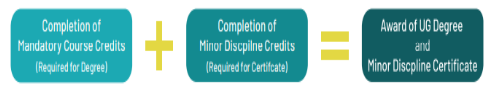
Navrachana University offers its students’ the opportunity to pursue a Minor discipline along with their major degree program, following one’s interest, which facilitates the growth of additional skills. Minors are a means of diversifying the understanding of a topic and a reflection of who one is as an individual. For example, a student of Bachelor of Business Administration (BBA) can choose a minor in ‘Interior Design’.
To attain a Minor, the students will need to do 18 credit worth of courses designated to diversify interests and gain a professional edge!
Health Science | Computer Science & Engineering | Business Law Interior Design | General Management | Mechatronics | Film Production
The Khoj program has been one of the defining social immersion activities at Navrachana University. Conceived right during the inception of the University, the Khoj program was envisaged to be a vehicle to inculcate social awareness, empathy, and interdisciplinary skills among our students, with a larger aim of proposing solutions to societal problems through innovation, it is through intense, rigorous, and field-based activities that students come up with an increased sense of empathy and awareness towards their surroundings. This program was further strengthened by engaging on topics that are relevant and can be made visible to society at large, the program is conceived as a larger and more ambitious activity that is undertaken by students and faculty members during the semester break under the umbrella of KHOJ WINTER SCHOOL.
Public Health & Hygiene | Mental Health | Environment & Sustainability | Waste Management | Urban Development | Economics & Social Issues.
8 Semesters | Full-time | Four-year | Undergraduate Degree Program|
Fee Structure: Rs. 58,000/- per semester
For Detailed Curriculum: Click here
Students undertake progressive internships after Semesters 2, 4, and 6, culminating in a full-semester (24-credit) Internship in Semester 8 with leading aerospace organizations. The Major Project in Semester 7 (4 credits) allows students to work on industry or research problems — from UAV design to satellite subsystems or sustainable propulsion — under faculty and industry mentorship.
Candidates should have passed 12th Standard (HSC) examination in Science Stream or equivalent examination from any school in India and should have secured a minimum aggregate score of 45% marks (40% marks for SC/ST/SEBC) in theory only, or in theory and practical with Physics, Mathematics as compulsory subjects along with Chemistry or Technical vocational subjects. The candidate should have appeared for qualifying examinations like JEE (Main) and/or GUJCET, etc.
Admission to 50% of the Program will be through ACPC (Admission Committee for Professional Courses), Government of Gujarat, on the basis of the merit list prepared by the ACPC.
The remaining 50% of seats will be filled by NUV based on HSC percentage and score in JEE (Main) or GUJCET examination.
Scholarships at Navrachana University
At Navrachana University, we believe in rewarding academic excellence and nurturing talent. Our scholarship programs are designed to support and encourage meritorious students across various disciplines. Explore the opportunities available and take a step closer to achieving your academic goals with us.
1.Pre- Teaching Sessions at the beginning of every semester.
Pre-teaching sessions, conducted at the beginning of every semester, serve as vital preparatory sessions aimed at providing students with foundational knowledge and essential skills necessary for success in their upcoming courses. These sessions typically encompass a variety of activities and discussions designed to orient students, set academic expectations, and foster a conducive learning environment.
Description of what pre-teaching sessions may entail:
2. Course Audit every month
A monthly course audit is a systematic review process conducted to assess the progress and effectiveness of ongoing courses.
3. Academic Advisory Board
Academic Advisory Board consists of Program matter experts who provide guidance, expertise, and innovative pedagogy and continuous improvement within the academic.
4. Students feedback at the end of every semester
Student feedback serves as a valuable tool for assessing and improving the effectiveness of teaching and learning practices, fostering a culture of continuous improvement, and enhancing overall academic quality.
5. Organizing Expert talks and Workshops
6. Industrial visits and Study tours
Mentorship (Mentor- Mentee)
A mentorship program for students is designed to provide invaluable guidance, support, and opportunities for personal and professional development.
Ratio of Mentor: Mentee is 1:35
Academic Advisors (for Electives and Minors)
Academic Advisors play a crucial role in guiding students through the selection, planning, and completion of elective courses and minors within their academic programs.
Navrachana University’s placement process is designed to make recruitment easy and flexible to optimize students’ success. We help students find the right opportunities based on their interests and aptitude and by matching them with recruiting organizations’ requirements. Click here to know more
